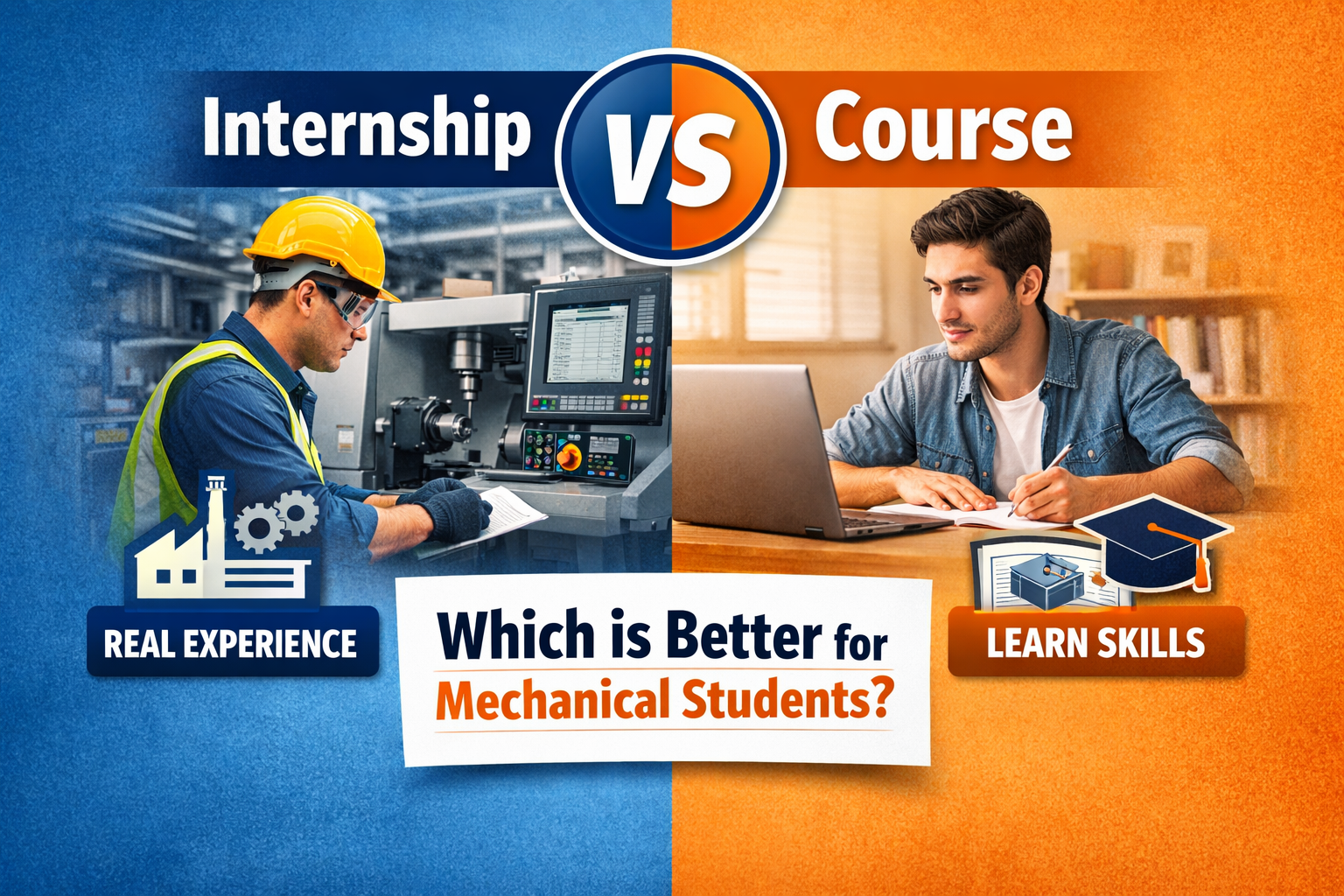
Internship vs Course: Which is Better for Mechanical Students?
Mechanical engineering students often face one common confusion:
Should I focus on a course or an internship?
This is an important decision because it directly affects your skills, confidence, and job opportunities. Many students either keep doing multiple courses without practical exposure or jump into internships without proper knowledge.
In this blog, you will clearly understand internship vs course, and which is better for mechanical students, with a practical approach.
What is a Course?
A course is a structured way to learn a skill or concept. It can be online or offline.
Examples of courses for mechanical students:
- CAD design (AutoCAD, SolidWorks, CATIA)
- CNC programming
- GD&T and FEA
- CAM software
A course helps you understand:
- Basics and fundamentals
- Software tools
- Engineering concepts
In simple terms,
Course = Learning phase
What is an Internship?
An internship is real-world training where you apply your knowledge in an industrial or company environment.
During an internship, you:
- Work on real projects
- Understand industry workflow
- Learn practical problem-solving
- Gain experience
In simple terms,
Internship = Practical experience
Internship vs Course: Key Difference
| Factor | Course | Internship |
|---|---|---|
| Purpose | Learn skills | Apply skills |
| Focus | Theory + basics | Practical work |
| Outcome | Knowledge | Experience |
| Environment | Classroom / Online | Industry / Company |
Which is Better for Mechanical Students?
The answer is simple:
Both are important, but at different stages.
When Course is Better
You should focus on a course if:
- You are a beginner
- You don’t have basic knowledge
- You want to learn tools like CAD, CNC, or FEA
Without learning fundamentals, an internship will not be useful.
When Internship is Better
You should focus on an internship if:
- You already have basic skills
- You want real industry exposure
- You are preparing for jobs
Internships help you:
- Gain confidence
- Improve communication
- Understand real work
Internship vs Course: What Do Companies Prefer?
Most companies do not focus on how many courses you completed.
They look for:
- Practical skills
- Project experience
- Internship exposure
So,
Internship with skills is always better than only courses.
Common Mistakes Mechanical Students Make
Many students make these mistakes:
- Doing too many courses without practice
- Joining internships without basic knowledge
- Not focusing on one skill
- Ignoring practical learning
This leads to confusion and lack of job readiness.
Best Strategy for Mechanical Students
Instead of choosing one, follow this step-by-step approach:
Step 1: Learn a Course
Choose one skill such as CAD or CNC and learn basics.
Step 2: Practice
Work on small projects and improve your understanding.
Step 3: Do Internship
Join an internship to apply your knowledge in real situations.
Step 4: Improve Skills
Learn advanced concepts and build a strong portfolio.
This is the most effective path to become job-ready.
Real Example
A mechanical student who wants to become a design engineer should:
- Learn CAD software like SolidWorks
- Practice part modeling and drawings
- Join a design internship
- Work on real projects
This approach gives both knowledge and experience.
How Many Courses Should You Do?
It is better to focus on:
- One or two strong courses
- Instead of many basic courses
Depth is more important than quantity.
How to Get Internship as a Mechanical Student
You can follow these steps:
- Learn basic skills
- Build simple projects
- Create a resume
- Apply through platforms like LinkedIn or Internshala
- Contact local companies
Do not wait for perfect knowledge. Basic skills are enough to start.
Final Verdict
- If you are a beginner, start with a course
- If you have basic skills, go for an internship
- If you want a job, do both in the right order
The correct formula is:
Course → Practice → Internship → Job
Conclusion
The confusion between internship vs course can be solved easily if you follow the right approach.
Courses give you knowledge.
Internships give you experience.
For mechanical students, both are important, but internship after skill development gives better career results.
If you focus on learning and applying skills step by step, you can build a strong career in mechanical engineering.