
Career Growth as a Mechanical Engineer: 5 Mindset Shifts
Career Growth as a Mechanical Engineer is not only about getting a good job, earning a higher salary, or getting promoted to the next designation.
It starts much earlier.
It starts with the way you think about your career, your work, your mistakes, your skills, and your future.
You may be a mechanical engineering student wondering what to do after graduation. You may be a fresher who has just entered a company. Or you may already be working as a Production Engineer, Design Engineer, Quality Engineer, Maintenance Engineer, or another engineering professional.
At every stage, one thing remains important:
Your technical skills can help you get an opportunity, but your mindset can influence how you use that opportunity.
Many students spend years asking:
“Which software should I learn?”
“Which company should I join?”
“How much salary can I get?”
These questions are important, but there is another question you should ask:
“What kind of engineer am I becoming?”
In this blog, let’s look at five simple mindset shifts that can help you approach your career differently.
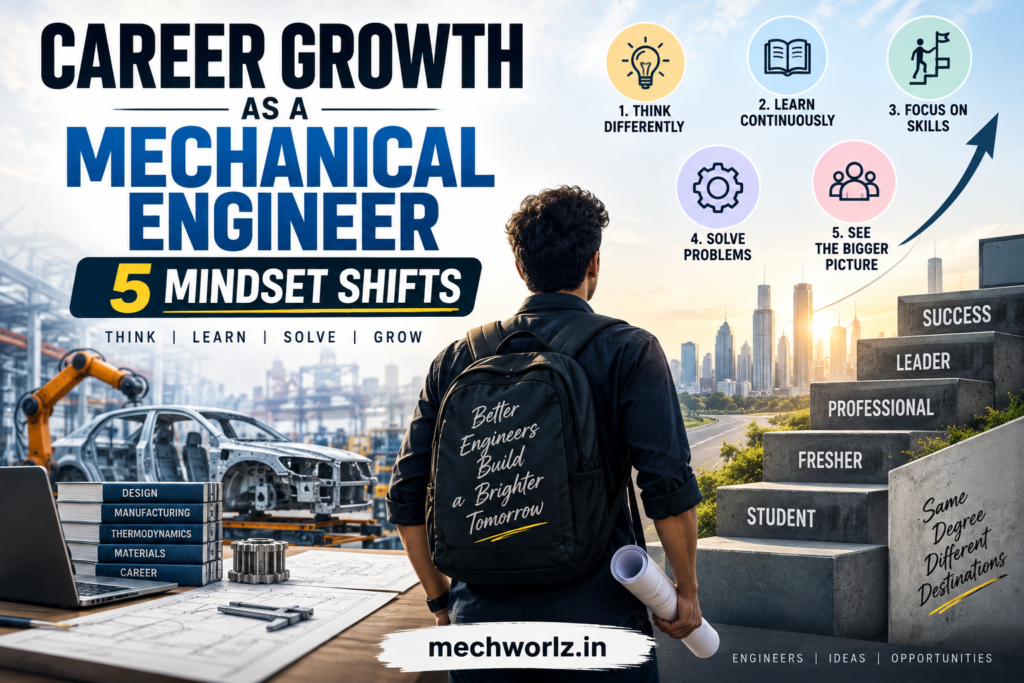
1. Think Like an Engineer, Not Just an Employee
When you join your first company, it is natural to focus on the tasks given to you.
Your supervisor says:
“Check these components.”
You check them.
Your manager says:
“Prepare this report.”
You prepare it.
Your team asks you to:
“Monitor the machine.”
You monitor it.
There is nothing wrong with completing your responsibilities.
But as you grow, try to go one step further.
Instead of asking only:
“What should I do?”
Start asking:
“Why are we doing it this way?”
For example, imagine you are working in a manufacturing plant and notice that a particular machining operation takes 60 seconds.
Instead of simply accepting it, start thinking:
- Can the cycle time be reduced?
- Is there unnecessary movement?
- Can the tool arrangement be improved?
- Is the machine being used efficiently?
- Can material handling be improved?
- Is there a better process?
You don’t necessarily need to change the process immediately.
First, understand it.
This is the difference between simply completing work and developing an engineering mindset.
A simple shift:
Task → Understand → Analyze → Improve
That mindset becomes increasingly valuable as your responsibilities grow.
2. Learn Before You Need the Skill
One common mistake students make is learning something only when an exam, interview, or job requires it.
For example:
You learn CAD because you have an interview.
You learn Excel because your manager asks for a report.
You learn GD&T because your company assigns you a drawing.
You learn PLC basics because your production line has an automation problem.
Instead, try something different.
Learn before you need the skill.
Mechanical engineering is a broad field. Depending on your career path, you may need knowledge of CAD, manufacturing, automation, quality, simulation, data analysis, project management, or other areas.
You don’t need to master everything.
Choose skills that are relevant to your direction.
If you are interested in Design
Explore:
- SolidWorks
- CATIA
- Creo
- GD&T
- Engineering Drawing
- FEA
- Design for Manufacturing
If you are interested in Production
Explore:
- Lean Manufacturing
- 5S
- Kaizen
- OEE
- Line Balancing
- CNC
- Process Planning
If you are interested in Quality
Explore:
- Root Cause Analysis
- 7 QC Tools
- SPC
- MSA
- FMEA
- PPAP
- APQP
If you are interested in Maintenance
Explore:
- Preventive Maintenance
- Predictive Maintenance
- TPM
- Hydraulics
- Pneumatics
- PLC basics
- Reliability Engineering
You can also use structured learning resources such as NPTEL, which provides courses covering mechanical engineering topics including manufacturing, CAD/CAE, robotics, thermodynamics, fluid mechanics, and many others.
The mindset shift:
Don’t learn because you are forced to. Learn because you want to be ready for the next opportunity.
3. Focus on Skills, Not Just Designations
One of the easiest ways to become frustrated in your career is to compare your designation with someone else’s.
You might see a classmate becoming a Senior Engineer while you’re still working as an Engineer.
You might see someone becoming a Manager while you’re waiting for your next promotion.
It’s natural to compare.
But instead of asking:
“Why haven’t I got that designation?”
ask:
“What skills does that person have that I need to develop?”
Suppose your goal is to become a manager.
Technical knowledge is important, but management also requires:
- Communication
- Team management
- Decision-making
- Project management
- Presentation skills
- Cost awareness
- Planning
- Leadership
So don’t prepare only for a designation.
Prepare for the responsibility behind the designation.
Think about it this way:
Designation = Position
Skills + Experience + Responsibility = Readiness for the Position
Your goal should be to become capable of handling the next level before you actually receive the title.
That is a healthier approach to career growth as a mechanical engineer.
4. Become a Problem Solver
Every engineering workplace has problems.
A machine stops.
A component fails.
Production is delayed.
A customer reports a defect.
A supplier sends incorrect material.
A drawing has an issue.
A process produces inconsistent results.
You can look at these situations in two ways.
Mindset 1:
“This is a problem. Someone should fix it.”
Mindset 2:
“This is a problem. What can I learn by understanding it?”
The second approach can change your career.
Suppose a machine experiences the same breakdown three times in one month.
A quick repair may get production running again.
But an engineer should also ask:
Why does this keep happening?
You might investigate:
- Root cause
- Machine condition
- Lubrication
- Alignment
- Operating conditions
- Maintenance history
- Component selection
- Operator practices
Now you’re not just repairing a machine.
You’re solving a recurring engineering problem.
Tools such as 5 Why Analysis, Fishbone Diagrams, Pareto Analysis, PDCA, and 8D can help you approach problems systematically.
The goal isn’t to become the person who fixes everything alone.
The goal is to become the engineer who can understand problems, identify causes, and help prevent them from happening again.
The mindset shift:
Problem → Analysis → Root Cause → Solution → Prevention
That is a valuable habit throughout your engineering career.
5. Understand the Bigger Picture
Imagine you’re working in Production.
It’s easy to think:
“My job is to meet today’s production target.”
But production doesn’t work alone.
Production depends on:
Planning → Materials → Machines → Manpower → Quality → Maintenance → Delivery → Customer
Every department affects another department.
For example, reducing machine downtime may increase production capacity.
Reducing defects may reduce customer complaints.
Improving material handling may reduce cycle time.
Improving preventive maintenance may reduce unexpected breakdowns.
Understanding these connections helps you see engineering from a broader perspective.
As you progress toward senior positions, this becomes even more important.
A senior engineer or manager doesn’t only need to understand the technical problem. They also need to understand its effect on:
- Cost
- Quality
- Productivity
- Safety
- Delivery
- Customer satisfaction
This is where you begin moving from a department mindset to a business mindset.
Professional organizations such as ASME also provide engineering resources, professional communities, courses, and career-related opportunities that can support continued development.
How to Apply These Mindset Shifts
Reading about mindset is easy.
Applying it is where the real change happens.
You don’t have to completely change your approach in one day.
Start with these five habits.
Every day, ask one question
“Why is this process done this way?”
It will improve your understanding.
Every week, learn one small thing
Spend a few hours learning a technical concept, software feature, manufacturing process, or industry practice.
Every month, document one improvement
It could be:
- Reduced cycle time
- Reduced rejection
- Improved maintenance
- Better documentation
- Improved safety
- Better process flow
Keep a record of your contributions. These examples can later become valuable during interviews, appraisals, and career discussions.
Every project, learn something outside your role
A Production Engineer can learn about Quality.
A Design Engineer can learn about Manufacturing.
A Quality Engineer can learn about Production.
A Maintenance Engineer can learn about Automation.
This cross-functional knowledge makes you more versatile.
Every year, review yourself
Ask:
- What did I learn this year?
- Which problems did I solve?
- Which skills did I develop?
- What can I do now that I couldn’t do last year?
- What should I learn next?
Your answers will give you a much clearer picture of your professional development.
5 Mindset Shifts at a Glance
| Old Thinking | Growth Thinking |
|---|---|
| “Complete my task.” | “Understand and improve the task.” |
| “I’ll learn when required.” | “I’ll prepare before I need it.” |
| “I need a better designation.” | “I need better skills and responsibility.” |
| “Someone should solve this problem.” | “Let me understand the problem.” |
| “My department is my world.” | “I should understand the complete process.” |
Final Thoughts
Career Growth as a Mechanical Engineer doesn’t happen only when you receive a promotion.
It happens every time you learn something new.
It happens when you solve a problem that others couldn’t solve.
It happens when you take responsibility instead of waiting for instructions.
It happens when you understand how your work affects the customer, the company, and your team.
And most importantly, it happens when you stop thinking:
“I am just doing my job.”
and start thinking:
“I am becoming a better engineer.”
You don’t need to know everything today.
You don’t need to learn every software.
You don’t need to become a manager in five years.
Start small.
Learn. Apply. Solve. Improve. Repeat.
That is how long-term career growth as a mechanical engineer is built.
Frequently Asked Questions
1. What is the most important mindset for a mechanical engineer?
A problem-solving mindset is one of the most useful. Instead of only identifying problems, learn to understand their causes and develop practical solutions.
2. How can a mechanical engineering student prepare for career growth?
Build strong engineering fundamentals, develop practical skills, learn relevant software, complete projects, improve communication, and understand different mechanical engineering career paths.
3. Should mechanical engineers learn multiple software tools?
Not necessarily. It is better to become genuinely capable in the tools relevant to your career path rather than collecting certificates for many unrelated software programs.
4. Can mindset really affect career growth?
Yes. Your approach to learning, responsibility, problem-solving, teamwork, and continuous improvement affects the opportunities you can take on as your career develops.
5. What should a fresher focus on first?
Focus on understanding your work, learning from experienced people, building technical fundamentals, asking good questions, and developing professional communication.