
Career Growth Ladder in the Automotive Industry: From Fresher to Leadership
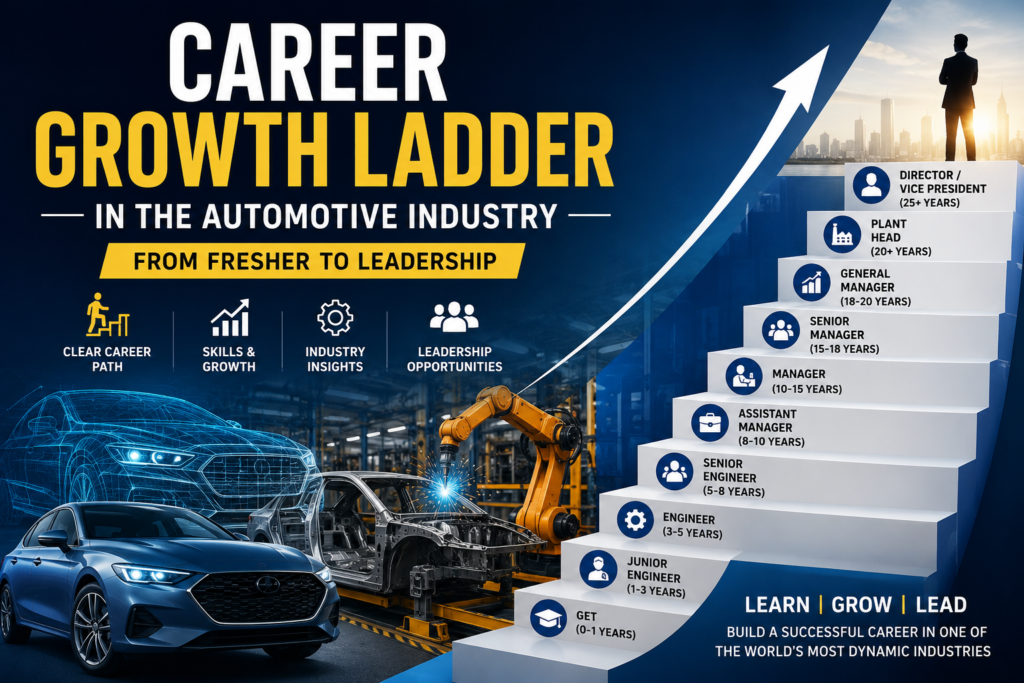
Career Growth Ladder in the Automotive Industry
When most mechanical engineering students think about their future, they often imagine themselves working in a large automotive company. The sight of modern manufacturing plants, advanced robotic systems, automated production lines, and world-class engineering facilities makes the automotive industry one of the most attractive career destinations for aspiring engineers.
Every year, thousands of graduates join companies like Maruti Suzuki, Tata Motors, Mahindra & Mahindra, Hyundai, Toyota, Honda, Ashok Leyland, Bosch, TVS Motor, Bajaj Auto, Hero MotoCorp, and hundreds of automotive component manufacturers. For many, getting selected is a dream come true. But once they step inside the factory, a new question arises:
“What happens after joining? How do I build a successful career from here?”
This is where many fresh engineers feel uncertain. They know how to secure their first job, but they don’t know what the next five, ten, or fifteen years should look like. Should they stay in Production? Move to Quality? Learn Design? Pursue higher studies? Change companies? These are important decisions that shape an engineer’s future.
The good news is that the automotive industry offers one of the most structured career paths in manufacturing. Every engineer, regardless of their starting point, has the opportunity to grow into leadership positions through continuous learning, practical experience, and consistent performance.
This article explains the complete career growth ladder in the automotive industry, the responsibilities at every stage, the skills you should develop, expected salary progression, and practical tips that can help you accelerate your career.
Why Choose the Automotive Industry?
The automotive industry is much more than manufacturing vehicles. It is a combination of engineering, technology, innovation, quality management, automation, and problem-solving. Every car, truck, motorcycle, or electric vehicle is built through the coordinated efforts of multiple engineering departments working together.
Mechanical engineers can build careers in:
- Production
- Quality Assurance
- Design & Development
- Maintenance
- Research & Development
- Manufacturing Engineering
- Supply Chain
- Industrial Engineering
- Project Management
With the rise of electric vehicles (EVs), autonomous driving technologies, robotics, and Industry 4.0, the demand for skilled engineers continues to grow. Engineers entering the industry today have the opportunity to work with advanced manufacturing technologies that were unimaginable just a decade ago.
Another major advantage is the clear career progression. Promotions are generally based on experience, performance, technical knowledge, leadership abilities, and contribution to the organization. If you consistently improve your skills and take ownership of your work, the industry offers excellent long-term growth opportunities.
Understanding the Career Growth Ladder
Your career in the automotive industry doesn’t change overnight. It grows step by step.
Every position prepares you for the next level of responsibility.
A typical career path looks like this:
Graduate Engineer Trainee (GET)
↓
Junior Engineer
↓
Engineer
↓
Senior Engineer
↓
Assistant Manager
↓
Manager
↓
Senior Manager
↓
General Manager
↓
Plant Head
↓
Director / Vice President
Although different companies may use slightly different designations, the overall progression remains almost the same.
Let’s understand each stage in detail.
Entry-Level Positions (0–2 Years)
Every successful engineer starts by learning. No matter how strong your academic knowledge is, the transition from classroom learning to real-world manufacturing is a completely different experience. During the first two years of your career, your focus should be on building a strong technical foundation, understanding manufacturing processes, and developing the right professional attitude.
1. Graduate Engineer Trainee (GET)
The Graduate Engineer Trainee (GET) role is the first step for most engineering graduates entering the automotive industry. Companies recruit GETs to train them in various departments before assigning them permanent responsibilities.
This phase is all about learning. You’ll rotate through departments such as Production, Quality, Maintenance, Design, or Planning to understand how the organization operates. You’ll attend technical training sessions, safety programs, and work alongside experienced engineers to gain practical exposure.
Don’t worry if you don’t understand everything in the beginning. Companies expect fresh graduates to learn, not to know everything on day one.
Your Responsibilities
- Learn manufacturing processes and production flow.
- Understand company standards and work procedures.
- Assist senior engineers in daily operations.
- Participate in safety and technical training.
- Prepare basic production and quality reports.
- Observe machine operations and workflow.
- Support improvement projects.
Skills to Develop
- Mechanical Engineering fundamentals
- Engineering drawing interpretation
- Basic CAD knowledge
- Communication skills
- Teamwork
- Observation skills
- Time management
- Positive learning attitude
Career Advice
Many freshers try to impress their managers by pretending to know everything. Instead, focus on learning. Ask questions, take notes, observe experienced operators, and understand why each process is performed. The knowledge you gain during your first year will become the foundation of your entire career.
2. Junior Engineer
After completing your training, you begin working as a Junior Engineer. At this stage, the company starts trusting you with independent responsibilities.
You’re no longer just learning—you are expected to contribute to production, quality, maintenance, or design activities. You’ll work closely with operators, supervisors, technicians, and senior engineers to achieve daily targets.
This is the stage where confidence begins to replace hesitation.
Key Responsibilities
- Monitor production activities.
- Coordinate with operators and supervisors.
- Troubleshoot basic manufacturing problems.
- Prepare daily production reports.
- Follow safety and quality standards.
- Support process improvements.
- Maintain production records.
Skills Required
- Problem-solving
- Root Cause Analysis
- MS Excel
- Production monitoring
- Basic ERP knowledge
- Effective communication
Career Advice
Build good relationships with operators and technicians. They have years of practical experience and can teach you valuable lessons that aren’t found in textbooks. Respecting every team member creates a positive work environment and helps you learn faster.
Mid-Level Positions (2–8 Years)
After gaining a few years of experience, your career begins to take shape. You’ll usually specialize in one department based on your interests, skills, and company requirements.
This is where engineers build their technical expertise and become specialists.
3. Production Engineer
If manufacturing excites you, Production Engineering can be one of the most rewarding career paths.
Production Engineers are responsible for ensuring that vehicles and components are manufactured safely, efficiently, and on time. Every day brings new challenges—machine breakdowns, manpower shortages, material delays, or quality issues—and solving these challenges becomes part of your routine.
Responsibilities
- Achieve daily production targets.
- Improve productivity.
- Reduce machine downtime.
- Coordinate manpower.
- Monitor production KPIs.
- Ensure workplace safety.
- Implement Lean Manufacturing practices.
- Improve Overall Equipment Effectiveness (OEE).
Important Skills
- Lean Manufacturing
- 5S
- Kaizen
- OEE
- Line Balancing
- Root Cause Analysis
- Time Study
- Production Planning
Career Tip
Don’t focus only on completing today’s production. Think about how to improve tomorrow’s production. Engineers who continuously improve processes become future leaders.
4. Quality Engineer
Quality is the reputation of every automotive company.
Customers expect every vehicle to meet high standards of safety, performance, and reliability. Even a small defect can lead to customer dissatisfaction or costly recalls.
That’s why Quality Engineers play such a crucial role.
Responsibilities
- Inspect components and finished products.
- Conduct process audits.
- Investigate defects.
- Analyze customer complaints.
- Implement corrective actions.
- Maintain quality documentation.
- Coordinate with suppliers.
Quality Tools
- APQP
- PPAP
- FMEA
- SPC
- MSA
- 8D Report
- Fishbone Diagram
- Pareto Analysis
Career Tip
A great Quality Engineer doesn’t simply find defects—they identify why the defect occurred and ensure it never happens again.
5. Design Engineer
Every automobile begins as an idea before it becomes a finished product.
Design Engineers transform those ideas into functional, manufacturable, and cost-effective components.
If you enjoy creativity, CAD software, and engineering calculations, Design Engineering can be an exciting career path.
Responsibilities
- Design automotive components.
- Create 3D models.
- Prepare manufacturing drawings.
- Modify designs based on testing.
- Coordinate with manufacturing teams.
- Support prototype development.
Software
- CATIA
- SolidWorks
- Creo
- NX CAD
- AutoCAD
Additional Skills
- GD&T
- DFMEA
- Material Selection
- Design Validation
- Product Lifecycle Management
Career Tip
A successful design isn’t just innovative—it must also be easy to manufacture, reliable, and economical.
6. Maintenance Engineer
A production line is only as good as the machines running it.
Maintenance Engineers ensure that equipment operates reliably with minimum downtime. Their work directly impacts productivity, delivery schedules, and manufacturing costs.
Responsibilities
- Preventive maintenance
- Predictive maintenance
- Machine troubleshooting
- Spare parts management
- Equipment installation
- Breakdown analysis
- Machine reliability improvement
Technical Skills
- Hydraulics
- Pneumatics
- PLC Basics
- Bearings
- Mechanical Drives
- Lubrication Systems
- TPM
Career Tip
Never wait for a machine to fail. The best maintenance engineers prevent failures before they occur through careful planning and regular inspections.
Senior-Level Positions (6–10 Years)
After spending several years solving technical problems, managing production challenges, and improving manufacturing processes, your career enters an exciting phase. At this stage, you’re no longer recognized only for your technical expertise but also for your ability to lead teams, make decisions, and drive improvements.
The expectations from the company change significantly. Instead of asking, “Can you complete this task?”, your managers begin asking, “Can you lead this project?” or “Can you mentor the new engineers?”
This is where your journey from an engineer to a future leader truly begins.
7. Senior Engineer
A Senior Engineer is someone who has gained strong technical knowledge and practical experience. You’re no longer just responsible for your own work—you become a guide for junior engineers and a reliable problem solver for your department.
Whether you’re in Production, Quality, Design, or Maintenance, people will start approaching you for advice because they trust your experience.
Key Responsibilities
- Lead improvement projects.
- Mentor Graduate Engineer Trainees and Junior Engineers.
- Solve complex technical problems.
- Coordinate with multiple departments.
- Improve productivity and quality.
- Analyze production data and recommend improvements.
- Support customer audits and technical reviews.
- Ensure company standards are followed consistently.
Skills Required
- Advanced technical knowledge
- Analytical thinking
- Project coordination
- Presentation skills
- Team collaboration
- Data-driven decision making
Career Advice
Many engineers believe promotions come automatically with experience. In reality, organizations promote people who take ownership. Volunteer for challenging projects, participate in continuous improvement initiatives, and don’t hesitate to share your ideas during meetings. Visibility and initiative often open doors to leadership opportunities.
8. Assistant Manager
Becoming an Assistant Manager is one of the biggest turning points in an engineer’s career.
Until now, your success depended mainly on your technical skills. From this stage onward, your leadership abilities become equally important.
As an Assistant Manager, you’ll manage a team of engineers, supervisors, and operators. You’ll plan daily operations, allocate resources, review performance, and ensure that production goals are achieved without compromising quality or safety.
Your role shifts from doing the work to ensuring the work gets done efficiently through your team.
Key Responsibilities
- Manage production or departmental activities.
- Allocate manpower and resources.
- Review daily production and quality reports.
- Monitor Key Performance Indicators (KPIs).
- Coordinate with Planning, Purchase, Maintenance, and Quality departments.
- Handle customer and supplier communications when required.
- Conduct team meetings and performance reviews.
- Ensure compliance with safety and quality standards.
Skills Required
- Leadership
- Decision making
- Time management
- Conflict resolution
- Communication
- Resource planning
- Team motivation
Career Advice
Your technical knowledge may help you become an Assistant Manager, but your people skills will determine how successful you become. Learn to listen, communicate clearly, and support your team. Great managers build strong teams, not just strong machines.
Management Level (10–15 Years)
At the management level, your responsibilities extend beyond individual departments. You’re expected to align operations with business goals, improve profitability, and contribute to the organization’s long-term success.
9. Manager
Managers play a crucial role in ensuring that departmental objectives support the company’s overall business strategy.
You’ll oversee operations, monitor performance, optimize costs, and ensure customer commitments are fulfilled. Instead of focusing on day-to-day technical issues, you’ll spend more time on planning, reviewing reports, analyzing trends, and making strategic decisions.
Key Responsibilities
- Manage complete departmental operations.
- Develop production and quality improvement plans.
- Monitor budgets and operational costs.
- Improve productivity and efficiency.
- Review departmental KPIs.
- Conduct employee performance evaluations.
- Coordinate with customers and suppliers.
- Lead continuous improvement initiatives.
Skills Required
- Strategic planning
- Budget management
- Leadership
- Business communication
- Negotiation
- Risk management
- Performance analysis
Career Advice
At this level, think like a business leader rather than just an engineer. Every decision should improve quality, reduce costs, increase productivity, or enhance customer satisfaction.
10. Senior Manager
Senior Managers oversee multiple departments or major business functions. They ensure different teams work together effectively while supporting the company’s long-term objectives.
This role requires balancing operational excellence with strategic planning.
Key Responsibilities
- Supervise multiple departments.
- Develop long-term operational strategies.
- Lead major improvement projects.
- Optimize plant performance.
- Manage departmental budgets.
- Coach department managers.
- Review business performance metrics.
Skills Required
- Cross-functional leadership
- Financial awareness
- Organizational planning
- Change management
- Business strategy
- Leadership development
Career Advice
Success at this stage depends on your ability to develop future leaders. The strongest Senior Managers create teams that can perform even in their absence.
Leadership Level (15–20+ Years)
By now, you’ve accumulated years of technical knowledge, leadership experience, and business understanding. Your role evolves from managing departments to shaping the direction of the entire organization.
11. General Manager (GM)
A General Manager is responsible for overseeing major operational areas and ensuring all departments work together efficiently.
The focus shifts toward business growth, customer satisfaction, operational excellence, and long-term planning.
Key Responsibilities
- Lead multiple departments.
- Develop business strategies.
- Improve operational efficiency.
- Review financial performance.
- Drive continuous improvement programs.
- Support expansion and modernization projects.
- Strengthen customer relationships.
Career Advice
A successful General Manager combines engineering knowledge with business thinking. Understanding people, finances, operations, and customer expectations becomes just as important as technical expertise.
12. Plant Head
The Plant Head is responsible for the complete manufacturing facility. Every major decision related to production, quality, maintenance, logistics, safety, manpower, and profitability ultimately comes under this role.
It’s one of the highest operational positions within a manufacturing organization.
Key Responsibilities
- Manage complete plant operations.
- Ensure production targets are achieved.
- Maintain quality standards.
- Monitor plant safety.
- Optimize operational costs.
- Develop future leaders.
- Coordinate with corporate management.
- Drive operational excellence.
Skills Required
- Visionary leadership
- Strategic decision making
- Financial management
- Crisis management
- Organizational development
- Customer relationship management
Career Advice
A Plant Head isn’t successful because they know every machine in the factory. They’re successful because they know how to build systems, develop people, and make decisions that keep the entire organization moving forward.
13. Director / Vice President
This is the highest stage in the automotive career ladder. Directors and Vice Presidents focus on business growth, expansion, innovation, investment decisions, and long-term organizational strategy.
They work closely with CEOs, board members, investors, and global leadership teams to define the company’s future direction.
Key Responsibilities
- Define organizational strategy.
- Drive innovation and digital transformation.
- Approve major investments.
- Lead business expansion initiatives.
- Develop organizational policies.
- Build global partnerships.
- Represent the company at industry forums.
Career Advice
Reaching this level is not just about years of experience. It’s about consistently delivering results, building trust, developing leaders, and making decisions that create lasting value for the organization.
Essential Skills That Accelerate Your Career Growth
Your designation may change every few years, but your skills determine how fast you move up the career ladder. Two engineers with the same experience can have completely different careers because one continuously learns while the other stays in their comfort zone.
The automotive industry values engineers who solve problems, improve processes, and contribute to business goals. The more value you create, the faster your career grows.
Here are the most important skills every automotive engineer should develop.
1. Strong Technical Fundamentals
Never underestimate the importance of engineering basics. Concepts like Thermodynamics, Strength of Materials, Manufacturing Processes, Machine Design, Engineering Mechanics, and Materials Science are applied every day in the automotive industry.
Whenever you’re troubleshooting a machine, analyzing a design failure, or improving a production process, these fundamentals help you make better decisions.
Tip: Keep revising your core mechanical subjects even after getting a job.
2. Problem-Solving Ability
Factories face hundreds of problems every day.
- Machine breakdowns
- Quality defects
- Production delays
- Material shortages
- Customer complaints
Your value as an engineer depends on how effectively you solve these challenges.
Learn structured problem-solving techniques like:
- 5 Why Analysis
- Fishbone Diagram
- PDCA Cycle
- 8D Problem Solving
- Root Cause Analysis
Companies appreciate engineers who solve the root cause rather than repeatedly fixing the same issue.
3. Communication Skills
Many technically brilliant engineers struggle to grow because they cannot communicate their ideas effectively.
In automotive companies, you’ll regularly communicate with:
- Operators
- Supervisors
- Managers
- Customers
- Suppliers
- Auditors
- Cross-functional teams
Being able to explain technical concepts clearly, write professional emails, present reports, and participate confidently in meetings can significantly impact your career.
Remember, people promote engineers they trust—and clear communication builds trust.
4. Leadership Skills
Leadership doesn’t begin when you become a manager.
It begins the moment you take ownership of your work.
Leadership means:
- Taking responsibility
- Supporting teammates
- Making informed decisions
- Guiding junior engineers
- Staying calm under pressure
- Inspiring confidence during difficult situations
Companies look for leadership potential long before they offer leadership positions.
5. Digital and Software Skills
Modern automotive manufacturing is becoming increasingly digital. Engineers who are comfortable with software tools gain a competitive advantage.
Useful software includes:
Design
- CATIA
- SolidWorks
- Creo
- Siemens NX
- AutoCAD
Manufacturing
- SAP
- Oracle ERP
- MES Software
- PLC Programming Basics
Data Analysis
- Microsoft Excel (Advanced)
- Power BI
- Minitab
Learning these tools improves productivity and prepares you for Industry 4.0 environments.
Certifications That Add Value
A degree gets you into the industry.
Certifications help you move ahead faster.
Some of the most valuable certifications include:
Manufacturing
- Lean Manufacturing
- Six Sigma Green Belt
- Six Sigma Black Belt
- Kaizen
- TPM
- 5S Implementation
Quality
- IATF 16949
- ISO 9001
- APQP
- PPAP
- FMEA
- SPC
- MSA
Design
- CATIA Professional Certification
- SolidWorks Professional (CSWP)
- Creo Certification
- GD&T Certification
Maintenance
- PLC Programming
- Hydraulics
- Pneumatics
- Predictive Maintenance
- Reliability Engineering
Project Management
- PMP
- Agile Fundamentals
- Project Planning
Choose certifications based on your career path rather than collecting certificates without practical application.
Salary Growth in the Automotive Industry
Salary varies depending on the company, location, skills, and performance. The figures below represent approximate annual salary ranges in India.
| Position | Experience | Approximate Salary (LPA) |
|---|---|---|
| Graduate Engineer Trainee | 0–1 Year | ₹3 – ₹5 LPA |
| Junior Engineer | 1–3 Years | ₹4 – ₹6 LPA |
| Engineer | 2–5 Years | ₹5 – ₹8 LPA |
| Senior Engineer | 5–8 Years | ₹8 – ₹12 LPA |
| Assistant Manager | 7–10 Years | ₹10 – ₹15 LPA |
| Manager | 10–15 Years | ₹15 – ₹22 LPA |
| Senior Manager | 15–18 Years | ₹20 – ₹30 LPA |
| General Manager | 18–22 Years | ₹30 – ₹45 LPA |
| Plant Head | 20+ Years | ₹40 – ₹70 LPA+ |
| Director / Vice President | 25+ Years | ₹60 LPA to ₹1 Crore+ |
These figures are indicative. Premium OEMs, multinational companies, and professionals with niche expertise may earn considerably more.
Common Mistakes That Slow Career Growth
Many engineers work hard but don’t progress because they repeat avoidable mistakes. Recognizing these early can save years of frustration.
Waiting for Promotions Instead of Earning Them
Promotions are based on value, not just years of service. Engineers who take initiative, solve problems, and contribute beyond their assigned tasks are noticed first.
Stopping Learning After Getting a Job
Graduation is the beginning of professional learning, not the end. Technologies, manufacturing practices, and customer expectations evolve continuously. Keep upgrading your knowledge.
Ignoring Soft Skills
Technical expertise alone is rarely enough for leadership roles. Communication, teamwork, adaptability, and emotional intelligence become increasingly important as your responsibilities grow.
Avoiding Challenging Assignments
Difficult projects often provide the greatest learning opportunities. Volunteering for them demonstrates commitment and accelerates professional growth.
Focusing Only on Your Department
Understanding how Production, Quality, Maintenance, Supply Chain, and Planning interact makes you a more effective engineer and prepares you for management positions.
Tips to Accelerate Your Career
If you want to reach leadership positions faster, adopt these habits early in your career:
- Treat every problem as an opportunity to learn.
- Read technical books and industry publications regularly.
- Learn from experienced operators and senior engineers.
- Keep a record of the improvements you’ve implemented.
- Build expertise in one area while understanding related functions.
- Develop both technical and interpersonal skills.
- Be punctual, reliable, and accountable.
- Stay updated on emerging technologies.
- Build a strong professional network.
- Maintain integrity and professionalism in every role.
Career growth is a marathon, not a sprint. Consistency often matters more than occasional bursts of effort.
The Future of Careers in the Automotive Industry
The automotive industry is entering a transformative era driven by electrification, automation, digitalization, and sustainability.
Engineers who adapt to these changes will find exciting opportunities in:
- Electric Vehicles (EVs)
- Battery Technology
- Autonomous Driving Systems
- Advanced Driver Assistance Systems (ADAS)
- Smart Manufacturing
- Robotics and Automation
- Artificial Intelligence in Manufacturing
- Digital Twins
- Industrial IoT
- Sustainable Manufacturing
Future engineers will need to combine traditional mechanical knowledge with digital and analytical skills to remain competitive.
Frequently Asked Questions (FAQs)
1. Which department offers the best career growth in the automotive industry?
There is no single “best” department. Production, Quality, Design, Maintenance, and R&D all offer excellent opportunities. The right choice depends on your interests, strengths, and long-term career goals.
2. How long does it take to become a Manager?
In many organizations, engineers reach managerial positions after approximately 10–15 years of consistent performance, though this varies based on company policies and individual achievements.
3. Is changing companies necessary for career growth?
Not always. Many engineers build successful careers within a single organization. However, strategic job changes can sometimes provide broader experience, better compensation, or faster advancement.
4. Which software should a mechanical engineer learn?
Popular choices include CATIA, SolidWorks, Creo, AutoCAD, SAP, Advanced Excel, Power BI, and Minitab, depending on your specialization.
5. Can diploma holders also grow into leadership positions?
Yes. Many organizations promote employees based on performance, skills, experience, and leadership potential rather than educational qualification alone.
Conclusion
A successful automotive career isn’t built overnight. It is the result of continuous learning, consistent performance, and the willingness to embrace new challenges.
Every designation—from Graduate Engineer Trainee to Director—comes with greater responsibilities, broader perspectives, and new opportunities to create value. The engineers who reach the top aren’t necessarily the smartest in the room; they’re the ones who never stop learning, adapt to change, and consistently deliver results.
Instead of focusing only on your next promotion, focus on becoming more capable every year. Learn new technologies, strengthen your technical and leadership skills, seek feedback, and take ownership of your work. Promotions and recognition naturally follow those who continuously improve.
Whether you’re a student preparing for your first job, a fresher stepping onto the shop floor, or an experienced engineer aiming for leadership, remember this:
Your career is not defined by where you start—it’s defined by how committed you are to growing every single day.